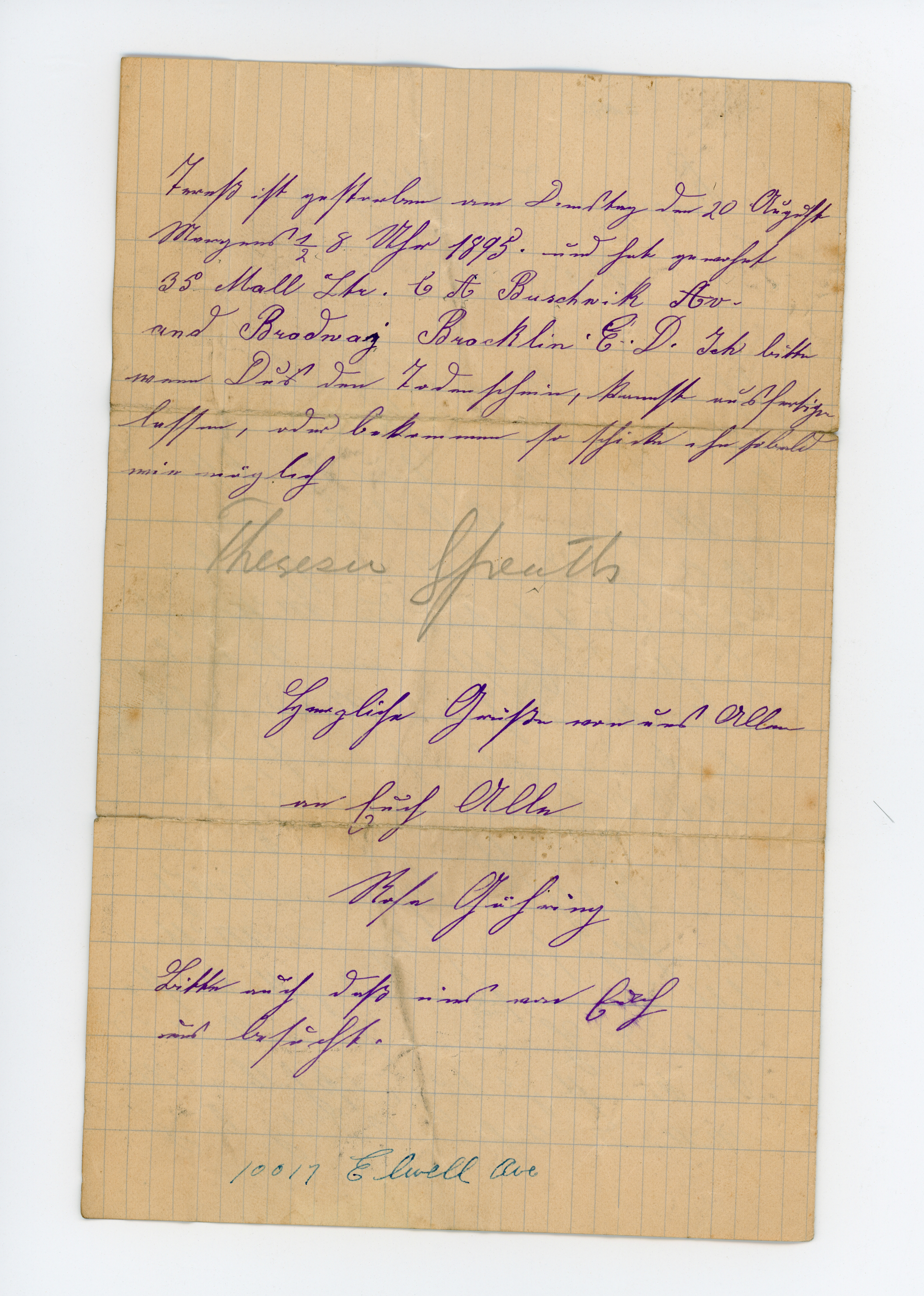
Discovery of Theresia's marriage to someone named Spaeth in letter from Rosa
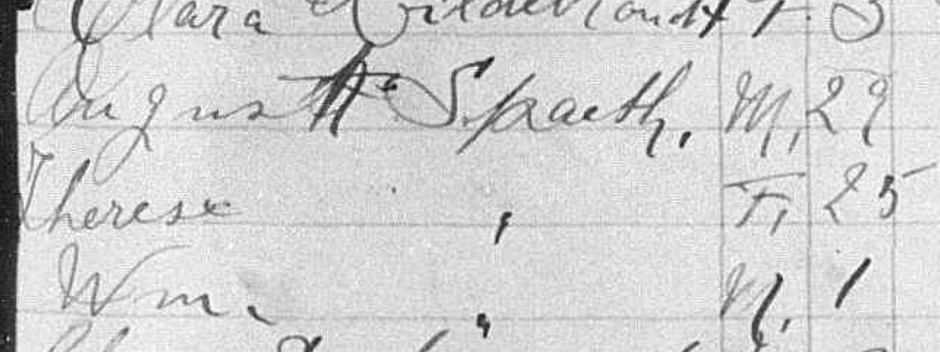
1892 Census showing August, Therese and William, in Brooklyn
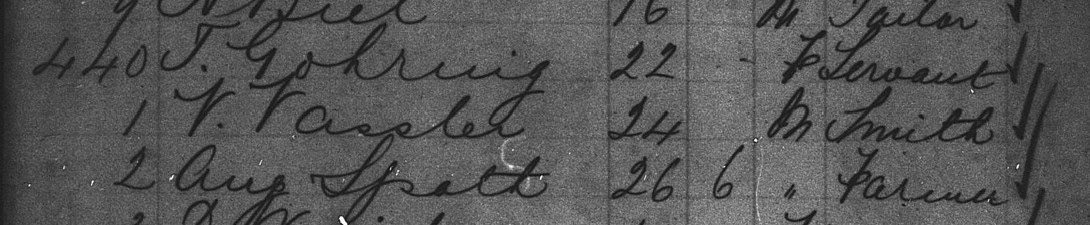
1889 ship manifest showing T. Gohring and Aug Spaeth
For the fourth of July weekend we had a bunch of family in town, including my cousin from the Bay area who has been doing genealogy research longer than I and who was itching for the opportunity to finally get her hands on all the “stuff” our grandpa left behind.
It’s been an experience, discovering the world of genealogy. I remember a time when my parents got into researching ancestors for a stretch. They may have been about my age and at the time I had zero interest. Now I’m thankful for the work they did because we’ve discovered some of the files they kept with lots of insightful information.
I’m not really sure why but genealogy tends to be an old person’s game. Fitting, then, that I’ve recently quit my job: now I’m a stereotypical retiree who spends her copious extra time doing genealogy research. My cousin and I got some good razzing from the rest of the family for skipping one of the get-togethers so we could “do genealogy.” We were conscious of boring especially the younger folk whose eyes glaze over pretty quickly once we get going. Instead, my cousin and I saved our discussion of dead ends, Ancestry.com frustrations, and endless information gaps for our time without the gang.
One thing we commiserated about a bunch is how easy it is to go down rabbit holes. You’ll find a thread and suddenly it’s an hour later and you’ve possibly not found any additional useful information and you’ve forgotten why you decided to follow that thread in the first place.
That said, there’s definitely a learning curve and I’ve gotten a lot better at figuring out how to do more than search for a name in Ancestry and Family Search – at least over the past couple of weeks, I’ve been pretty successful at finding quite a lot of new information. That moment when you discover a new database, enter some information, hit search and actually find what you’re looking for is pretty exhilarating. Or you look at a document that you’ve already looked at ten times but this time you notice something new that connects some dots. It’s part thrill of the chase, part compulsion to fit together a puzzle with a million missing pieces.
Let me give you an example. A couple of weeks ago I was re-reading some of the early German letters for the millionth time. I recalled several letters from Rosa to Franz where she’s asking him for help tracking down a death certificate for someone named Theresia. It’s all very complicated and additionally hard to understand due to the poor translation I’m working with but I believe that it's all related to accessing money after the death of Franz and Rosa’s father, Lorenz (I've updated the family tree so you can reference it if you get lost). Rosa’s assumption was that the money should be available to their mother but she keeps getting conflicting information from the bank and lots of requests from the bank for details of surviving family members. Somehow, Theresia’s death certificate was required before anything further could be done and Rosa was hopeful that Franz, in Cleveland, could help since the mystery Theresia had died in Brooklyn.
But the saga gets more complicated: Rosa also begins asking for help finding people named Will and August, also in New York. Someone was hired to look particularly for Will but no luck discovering any sign of him either alive or dead, according to the letters. I’d read these letters many times but didn't pay much attention to this somewhat tedious tale, probably because the names Theresia, August and Will meant nothing to me.
And then came two important eye openers: while several letters had included Theresia’s address in Brooklyn, one dated March 31, 1913 has her name added in pencil as Theresia Speath. Does that sound familiar? A Mr. Spaeth appears in an earlier letter from Lorenz to Franz, the one that supposes Mr. Spaeth went down with the SS La Bourgogne, the French ship that sank off the coast of Novia Scotia in 1898.
At around the same time I noticed that my cousin, who started our family tree on Ancestry.com, had discovered and added to the tree a sister of Franz and Rosa’s named Theresia. Aha! Now my wheels are turning with an obvious theory: Theresia moved to New York and at some point married a man whose last name was Spaeth and then she died at a young age. Now Rosa requires her death certificate to release their father's money. With the exact date of her death in hand from several references in Rosa’s letters, I got to work proving my theory of her immigration and marriage. I was particularly keen to discover if, now that I knew Mr. Spaeth’s first name could be either August or Will, I might find a death certificate showing that he went down on the big French ship.
What a tale I discovered. A Sept. 15, 1889 passenger manifest shows a German female T. Gohring traveling in steerage to New York. Theresia would have been 23 at the time. By chance, I happened to notice that a couple of names below hers on the list of passengers was an Aug Spaeth – it would be quite a coincidence if that wasn’t the Theresia Gohring who became Theresia Spaeth.
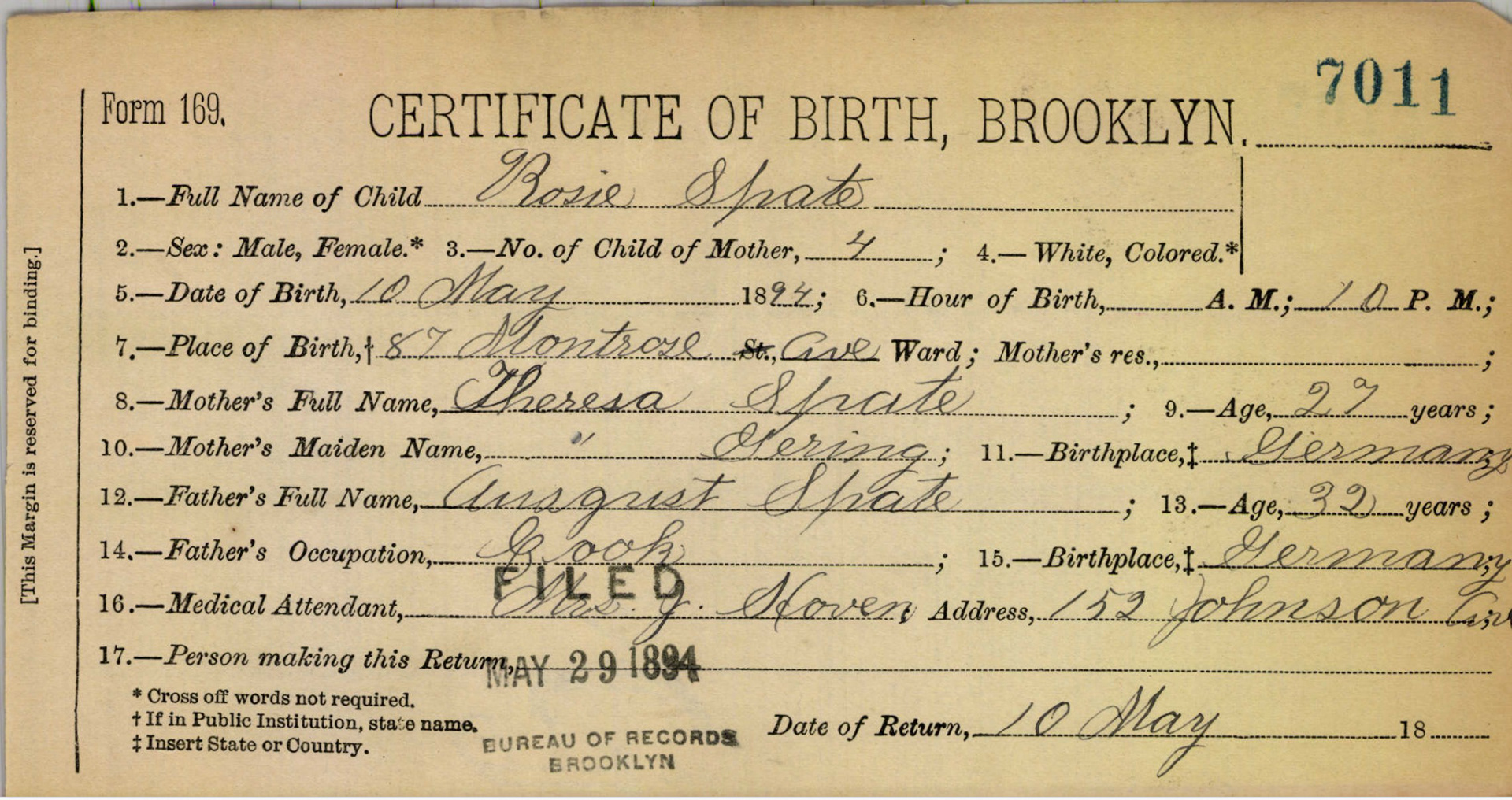
Rosie's birth certificate
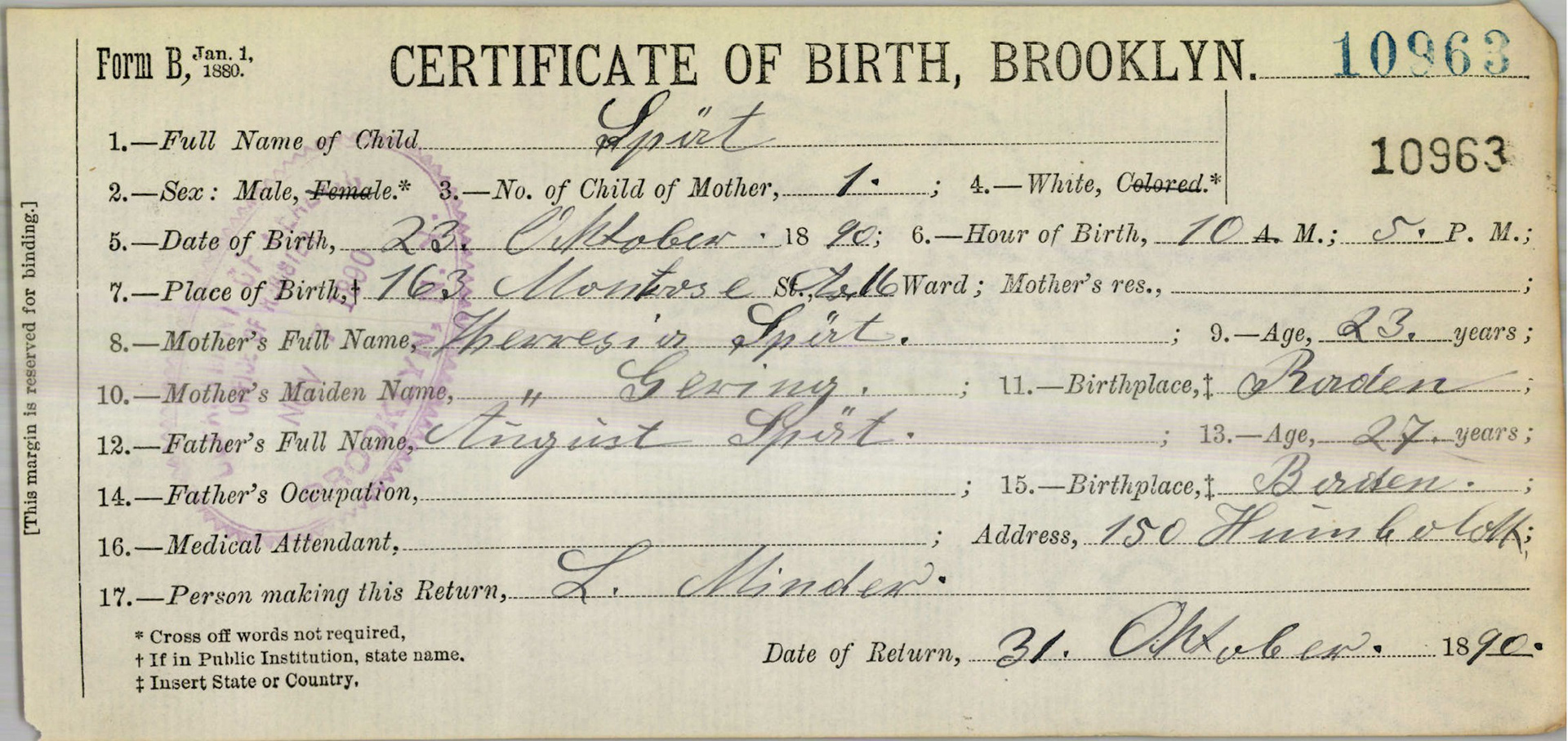
Possibly William's birth certificate
Next I found a suspect birth record, for parents August Spirt and Therresia, maiden name Gering, both from Baden in Germany, for an unnamed boy on Oct. 23, 1890. I’ve learned by now that people back then played fast and loose with name spelling so given the names, timing and location, there’s a good chance that this record is indeed our Theresia and August, especially because I also found a census for the following year showing an August Spaeth as head of household that included a Therese and a one-year-old son named William.
A couple of years later comes another badly spelled birth record: in this one, the parents are August Spate and Theresa Spate, maiden name Gering. This little one was a girl, named Rosie, presumably after our Rosa, Theresia’s sister.
At this point all my digging was pretty thrilling. What a neat story I’ve discovered about my great grand aunt, who traveled to Brooklyn at a young age in the late 1800s, got married and had some kids. But it’s here that the story takes a turn for the worse. Everything else I discovered just got sadder and sadder.
In 1895 at the very young age of 28 Theresia dies. Her death certificate says cause of death was gastro enteritis, and secondarily, peritonitis, of which she suffered for about four weeks. Ugh. That sounds quite grim, to die back then of some kind of digestive issue.
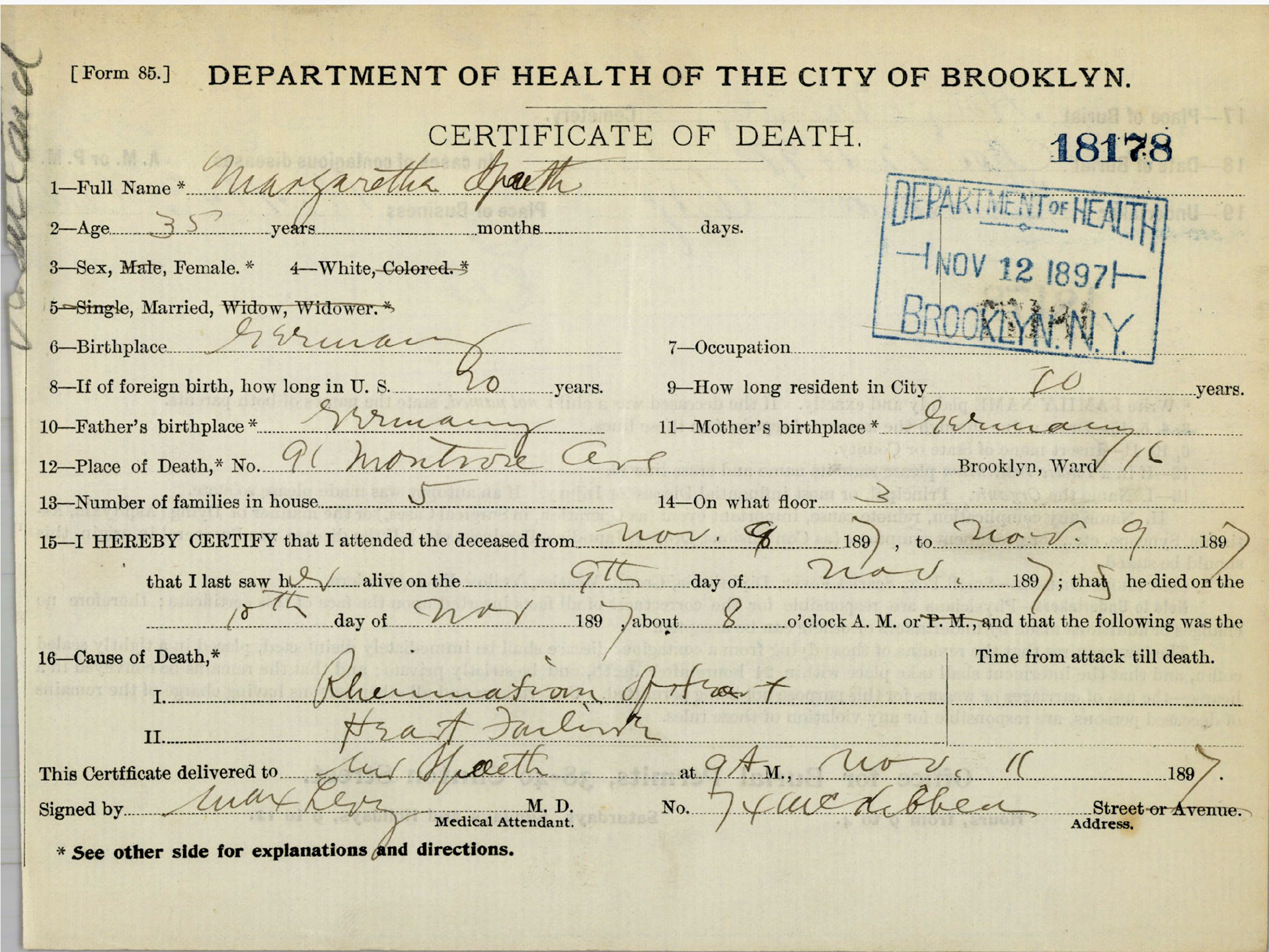
I was still very intrigued by the idea that our “Mr. Spaeth” might have died on the SS La Bourgogne so I turned my attention to him. The initial reference in the letter from Lorenz suggests that nobody had heard from him for a very long time but that Mr. Spaeth at some point indicated he might head home to Germany because now his second wife had died. That got me digging into the NYC Department of Records and Information Services which has been a gold mine of information about all of these people. I soon discovered that indeed our August remarried in April 1896, a woman named Margareth Schwenk. It was a second marriage for them both, her maiden name was Scharf and she was also from southwest Germany. But sadly, as we knew from Lorenz’s letter, our happy couple had just a year and a half together before she died in November 1897 of “rheumation of heart” and secondarily heart failure.
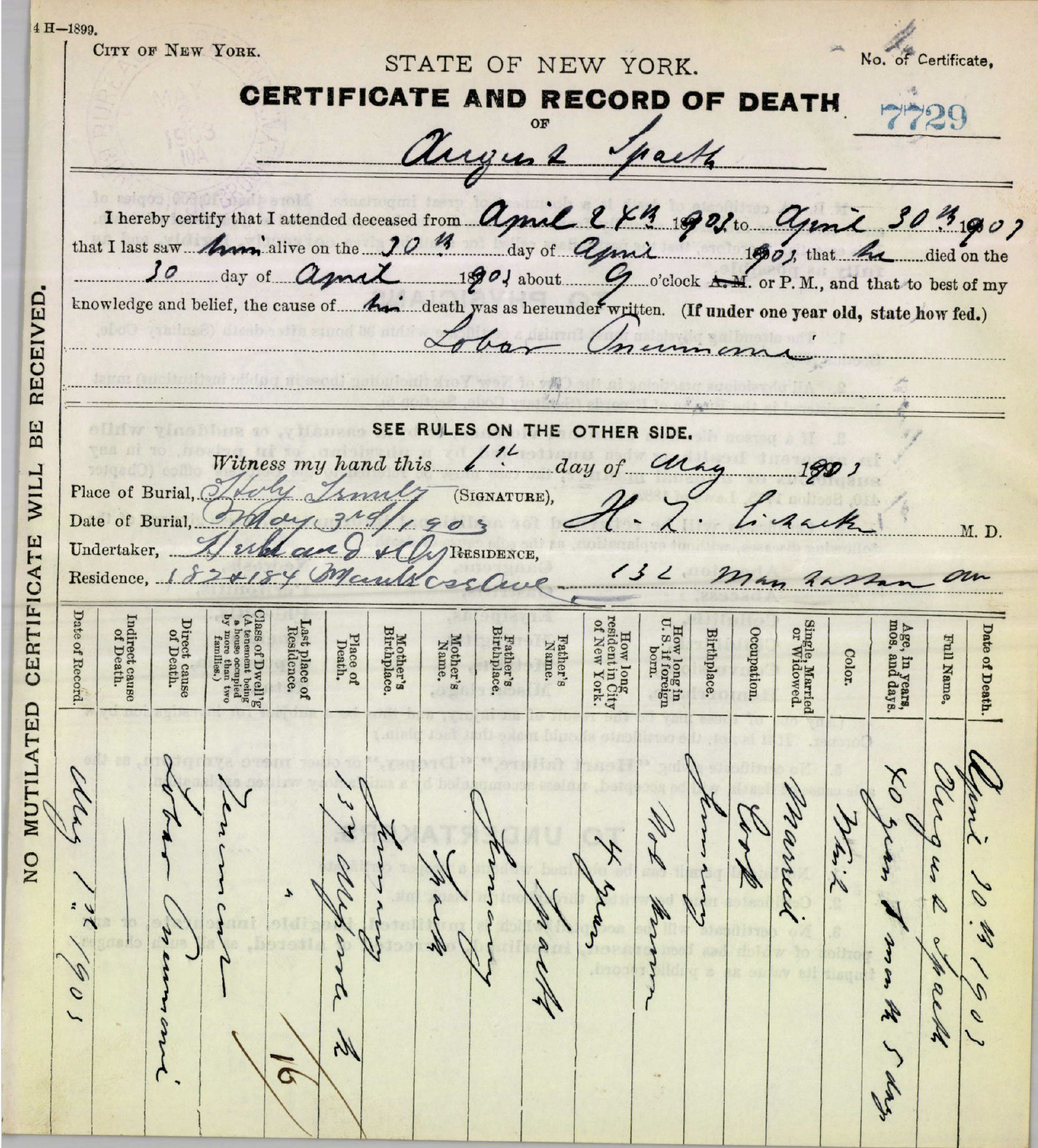
After all, I don’t think August went down with the ship. I found a death certificate for an August Spaeth from Germany who worked as a cook in New York and who died in 1903 of lobar pneumonia, a lung infection. I don’t know why he went radio silence before then in terms of communicating with the folks back home. It does look like his address changed so he must have moved at some point. Perhaps he was just worn down. Or maybe he did offer an update and neither Rosa nor Lorenz passed that on to Franz in the letters that we have. Speaking of address changes, the address for Theresia that Rosa shares with Franz in the letters is not the same address on any of the documents that we found. Another heartbreak: I wonder if the family back in Germany had written letters that Theresia never received.
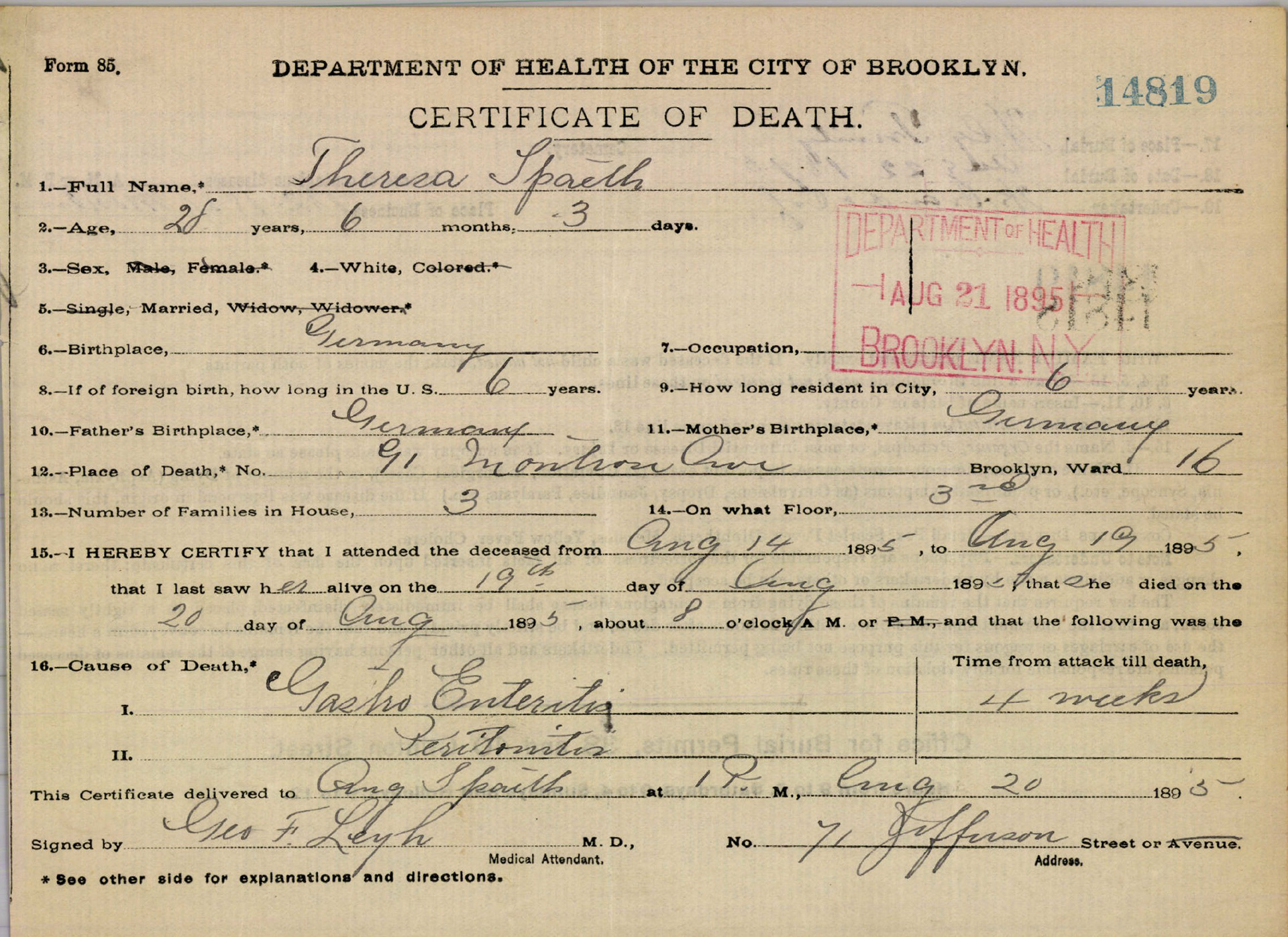
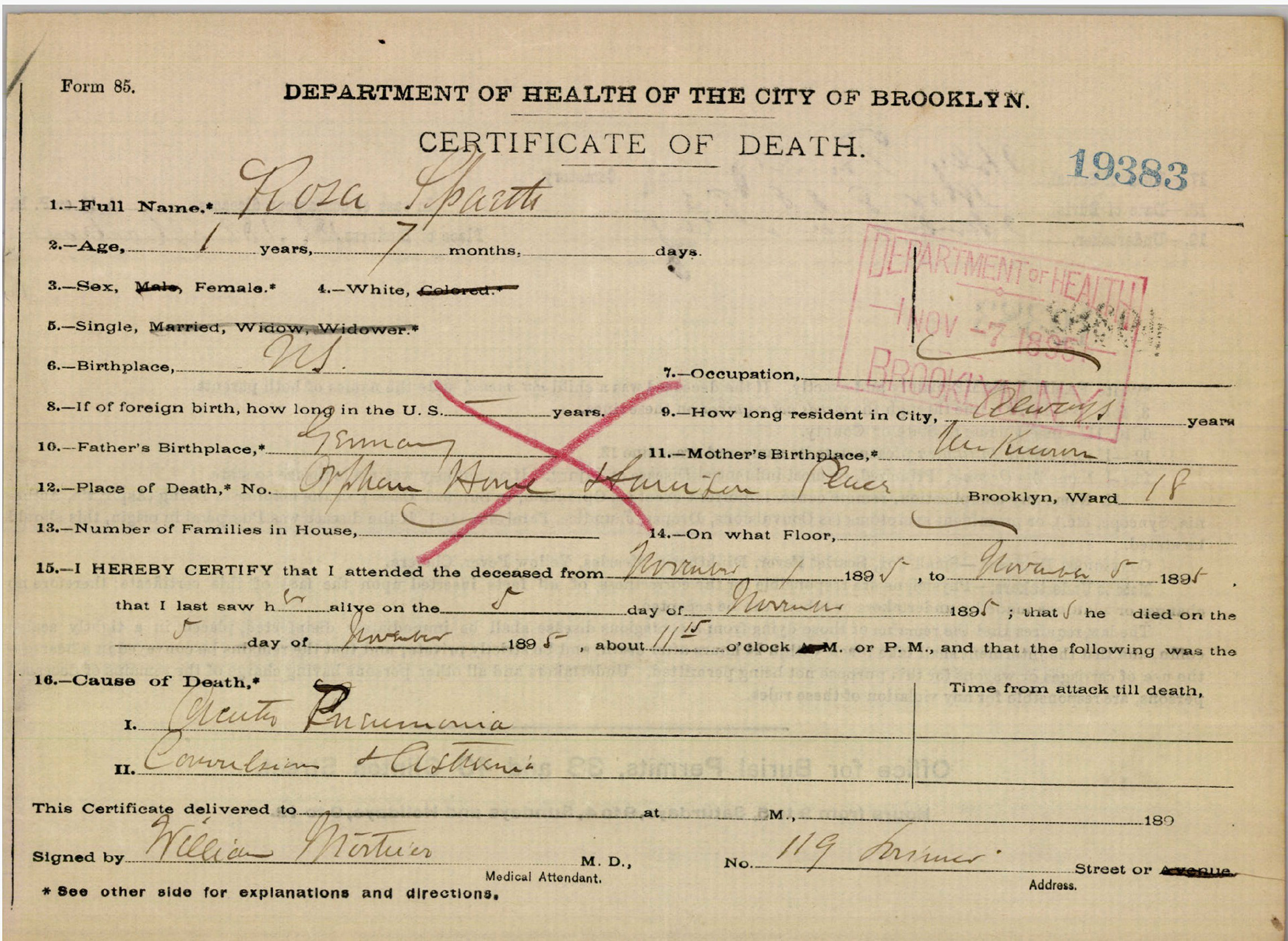
But meanwhile, what happened to August and Theresia’s kids? Here’s yet another heartbreak. Our Rosie was apparently given up as an orphan and died at a year and seven months old of acute pneumonia. For a minute when I discovered that she died in an orphanage I got mad at August. How could he have given her up? But the reality is he likely didn’t have great options. His profession is listed on several documents as a cook and he lived in an increasingly crowded tenement house: when he was there with Theresia there were three families sharing the residence but that grew to five families once he married Margarethe. How could he take care of his kids and still go to work once Theresia died? He wasn't wealthy and as an immigrant may not have had any family who might help. A sad story no matter how you slice it.
And now the mystery of William continues. Just like Rosa, I haven’t been able to find any record of him. He would have been five when his mother died and since Rosie was given to an orphanage, I wonder if Will was too – although Lorenz makes reference to Mr. Spaeth and his son in his 1898 letter to Franz so it sounds like father and son were possibly still together then. There should be some record of Will somewhere but I suppose there are a million reasons why I haven’t found one yet. He may have been taken in by someone and given a new last name. Or like Rosie he too died at a young age and perhaps I haven’t yet guessed at a misspelled last name or maybe a death certificate wasn’t filed correctly.
The fun part of genealogy research is the thrill of the chase. But then sometimes the reality sets in. This isn’t just a meaningless puzzle to piece together. There’s a real life story here, riddled with all the human emotions, good and bad. I might try to make myself feel better by hoping that there was some joy in there amidst the struggle that this paper trail describes. But there’s no arguing that these people knew tremendous sadness.
Maybe it’s these thoughts that fuel genealogists. I’m surprised at how much I care about this Spaeth family. When I started on this whole project earlier this year I figured that it's natural I’m interested in my grandfather’s war story and the details surrounding his life – he’s my grandfather, I lived in his house, including a few years with him there before he died. I didn’t even know the Spaeth’s existed; it was only a couple of weeks ago that I even knew Theresia was a sister of Franz and Rosa’s. And yet her story is meaningful to me, both in the context as a distant relative and a real individual who was part of one of the great waves of immigration to America that we all learned about in history class as kids. The records we find are factual but they make it very easy to stitch together the real stories of the people whose milestones they document.
Sign up for updates. Share this post on the socials