The day my sister and I first found my grandpa's letters, we sat in the sun on my parent's enclosed back porch -- the best spot in the house, with a view of soaring trees and an occasional woodpecker -- and took a quick peak. We felt a bit guilty doing it. My dad had talked about these letters for decades. We hadn't a clue how many letters there were or if they'd be interesting but we always wanted to read them. Now that we finally found them, we thought it wasn't fair to dig in without our other sister and our husbands. So we decided to take just a quick look and then save them for when we were all together.
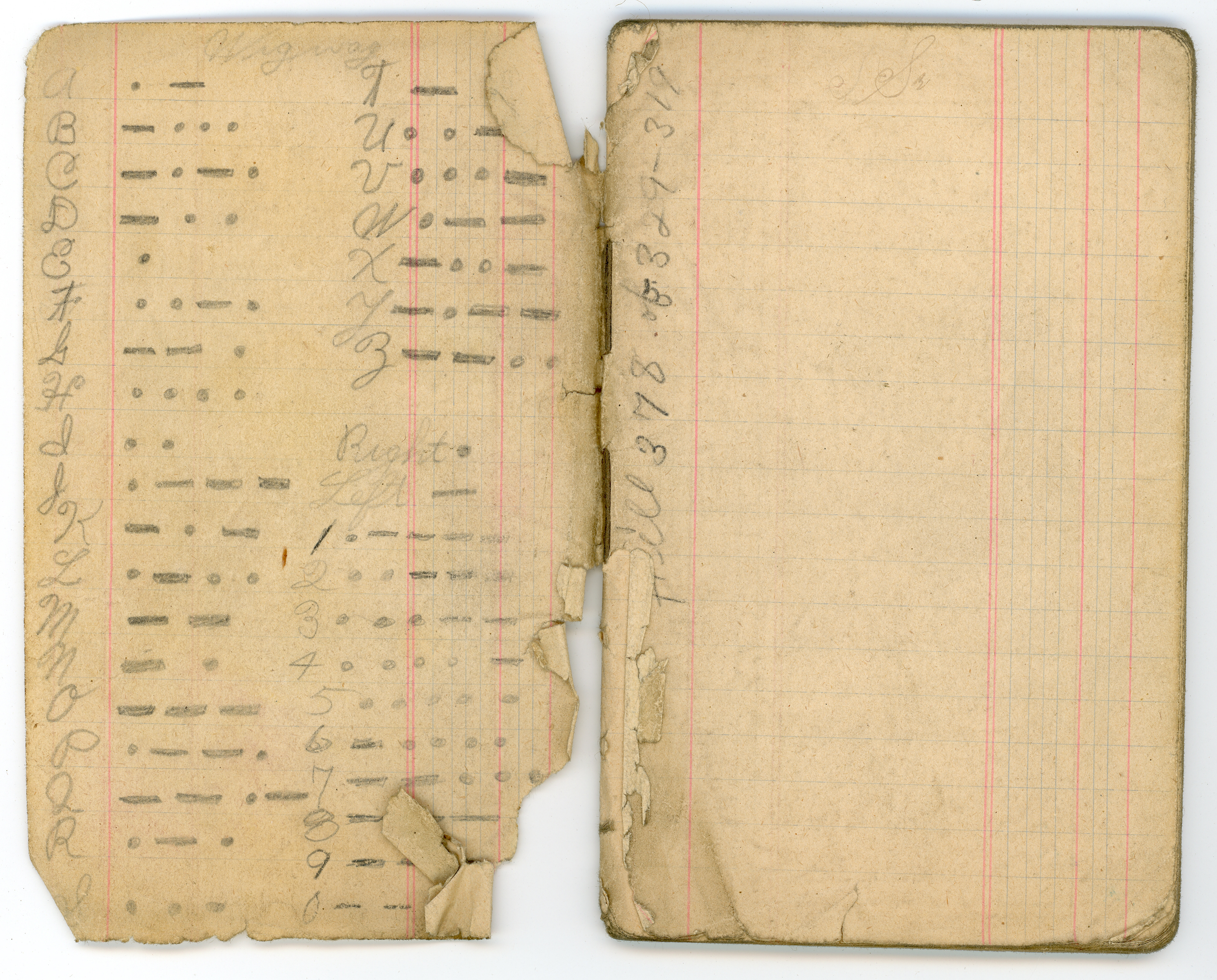
The letters were in an extremely heavy old wooden two-drawer filing cabinet that was the last thing we dragged out of the crawl space upstairs. They were jumbled in a couple of small boxes with other stuff like postcards, small books and newspaper clippings. I remember pulling out a beat up old notebook and my sister and I marveled at the Morse code written in pencil on the back pages. Near the front of the notebook were a few pages of scrawled writing that appeared to be written over time with different pencils and pens. At a glance I noticed dates and what looked like town names but it didn't mean much to me at the time and it was hard to decipher so I remember setting it aside so I could check out the books and open a letter or two.
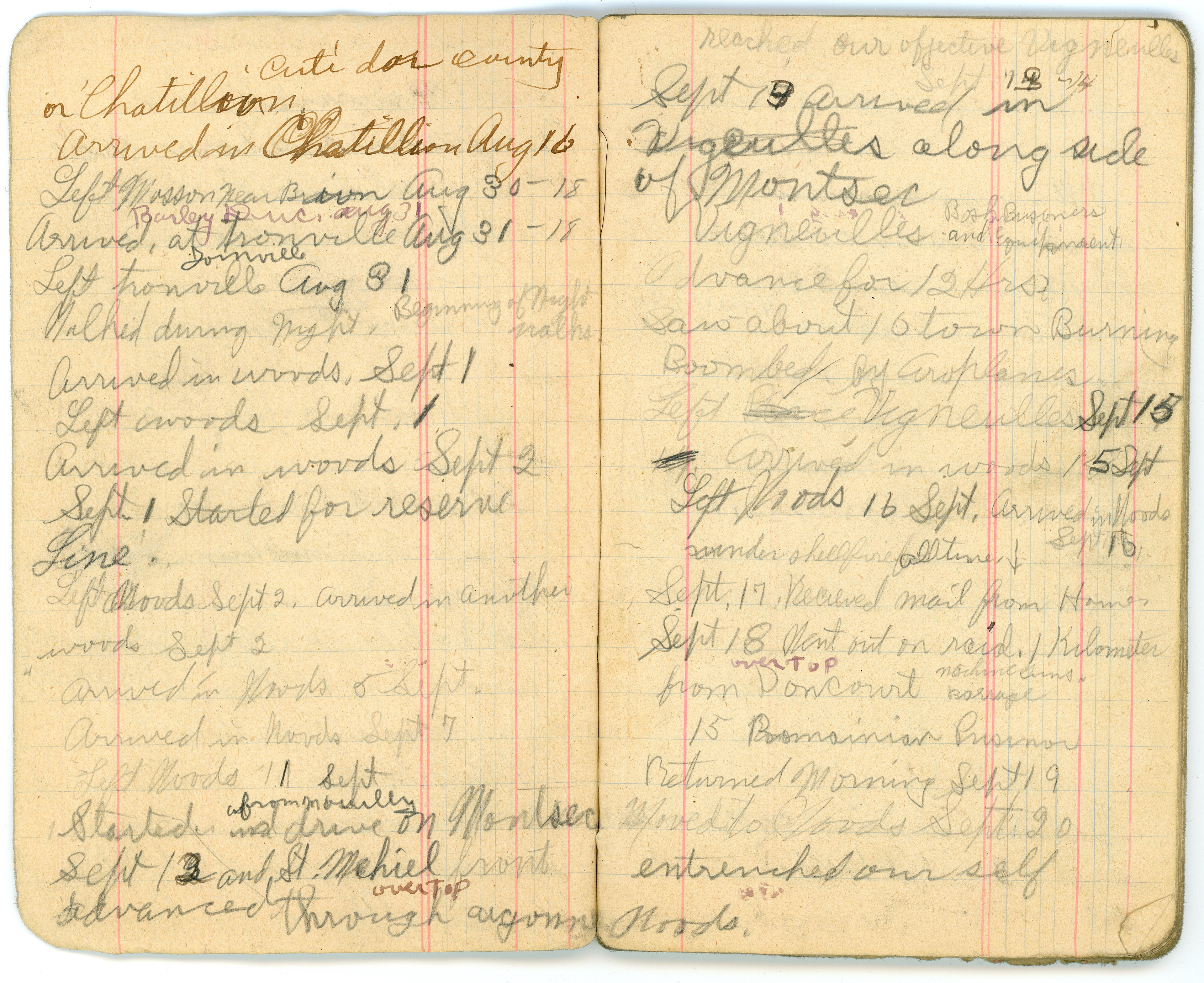
At some point later my sisters and I sat down together to read the letters and I started doing some reading online about some of the big battles that my grandpa's division fought in. The next time I picked up the little notebook, I began to recognize town names. I realized the notebook is a simple record of my grandpa's movements, where he jotted down his location day by day. My heart sunk the first time I saw the words "over the top." This little notebook now feels like a bit of a gold mine, sad and scary and crazy all at the same time.
I'll transcribe a couple pages of it below because it's hard to read but you can check it out in the pictures. I think the real action starts for my grandfather around Aug. 31, 1918 when he writes that he left Tronville, and then in the margins "beginning of night walks." Until Sept. 11 there's a lot of "left the woods" and "arrived in woods." Then:
Left woods 11 Sept.
Started from Mouilly drive on Montsec
Sept 12 and St Mehiel front
Advanced through Argonne Woods. Over top.
Reached our objective Vignuelles
Sept 13 arrived in Vignuelles along side of Montset
Vignuelles ? prisoners and equipment
Advance for 12 hours
Saw about 10 towns burning
Bombed by aeroplanes
Left Vignuelles Sept 15
Arrived in woods 15 Sept
Left woods 16 Sept
Under shellfire all times
Sept 17 received mail from home
Sept 18 went out on raid. 1 Kilometer from Doncourt. Over the top. Machine guns barrage
15 Romanian prisoners
Returned morning Sept 19
Moved to Woods Sept 20
entrenched our self
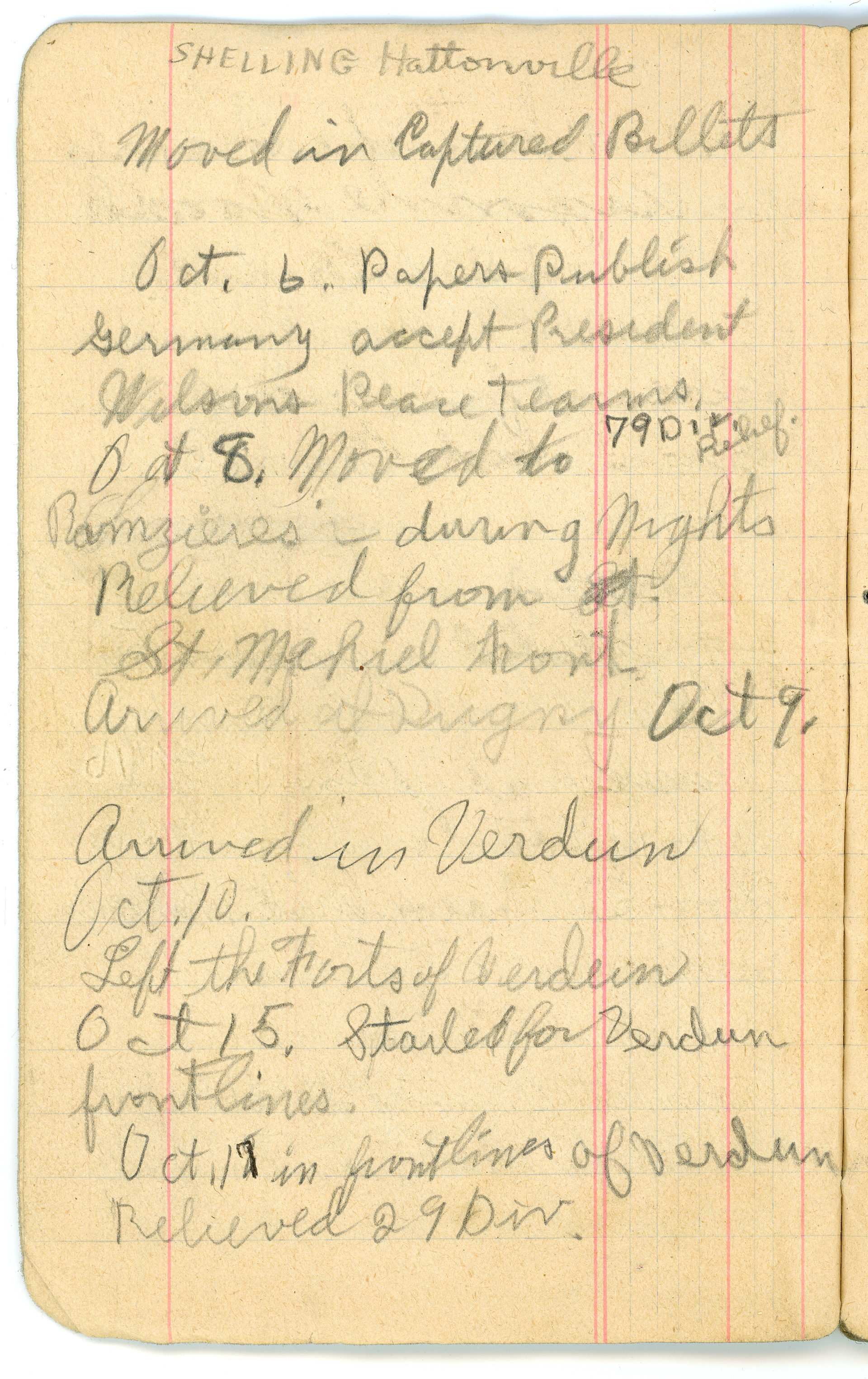
Shelling Hattonville
Moved in captured billets
Oct 6 Papers publish Germany accept President Wilson Peace Terms
Oct 8 moved to 79 div. relief Ranzieres during nights
Relived from St. Mihiel front
Arrived at (Dugny?) Oct 9
Arrived in Verdun Oct 10
Left the forts of Verdun Oct 15. Started for Verdun front lines
Oct. 17 in front lines of Verdun. Relieved 29 Div.
There's more, but I'll save what comes next for another day. Let me make a couple of observations. You'll notice that twice he mentions going "over the top" (just during this month, there's more to come for him.). That's when the troops were ordered on what sounds to me like basically a suicide mission, sent out of the trenches into no man's land -- the stretch between enemy trenches where you'd be out in the open, facing enemy fire. An extensive Wikipedia entry offers much more detail, including photos, if you'd like to read more about trench warfare and what it means to go over the top.
Also, this stretch of time begins with 11 days of night walks from Tronville to Mouilly. I mapped it and if you drove that today, it would be 85 miles. The very next day he's at the front and is sent over the top. To me, this month from mid-September through October sounds like madness. Hiking at night, moving from place to place, going on raids, advancing for 12 hours straight, taking prisoners, all under constant shellfire.
And then I read the letters. They only barely hint at what's happening, he really doesn't suggest much about what he's going through. I think he mostly tries to spare his parents the details – he writes that he doesn’t want them to worry. But he does make very brief references about the fighting and offers a bit more detail to his siblings.
“In the drive we reached our objective and caught a big number of prisoners, wagons, horses, kitchens, supply wagons, guns of all kinds, ammunition and also a German band,” he writes to his brother Leonard on Oct. 1. “Also got a lot of candy cakes and pumpernickel and all sorts of things. They didn’t fight back very much after we had them on the run. They held up their hands and hollered Komrad. They even have the Romanians fighting for them. That drive was a success. They set fire to all the towns they left behind until they made a stand.”
A few days later, on Oct. 5, he writes to his sister: “We have aeroplanes over here and when an enemy plane flies over you want to keep your self still or they bomb you but come over mostly to take pictures. Still they do not get very far over our lines for the aircraft guns open on them and they will beat it and quick. They have not as many planes as we have, I seen dozens of them in the air at one time, so high you could only see a bunch of dots." Of the Germans he says: “They mostly level the town all around us, keep pounding big shells in the towns for a few days and then the towns are level to the ground.”
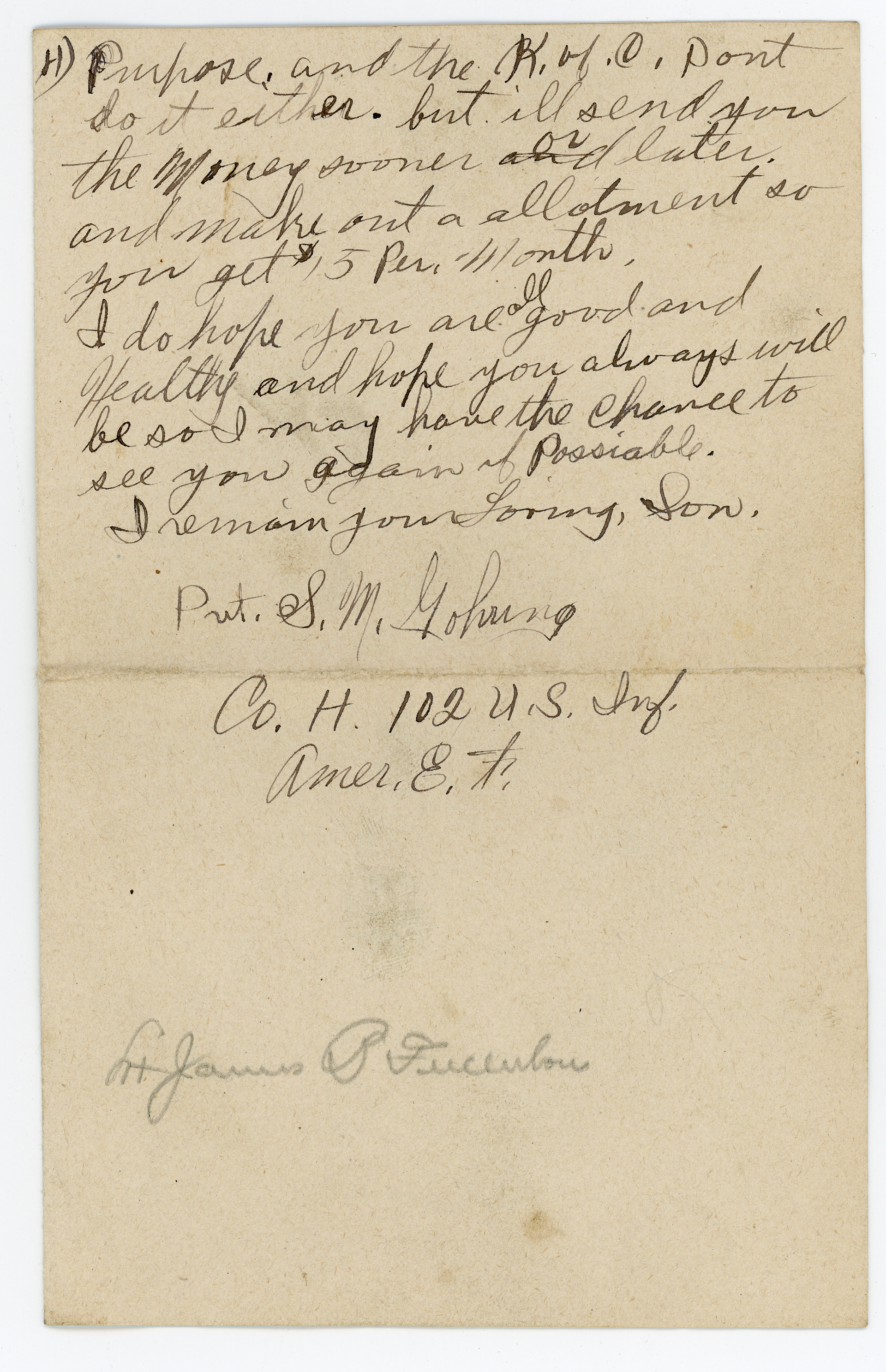
Obviously he's limited in what he can say because of the censors (note the censor's signature at the end of the letter at the bottom of this post). His family must have referenced a newspaper report about the fighting. “The paper was right about where we are and what we are doing but don’t worry or let that worry you any. I’m trying my best and hope I’ll always have the chance to try my best,” he writes. To stay up on his company, he suggests that they try to get their hands on newspapers from Connecticut since the Yankee Division originated in Connecticut and most of the men are from there.
He references sending along some newspapers and I'm not sure if those were saved. I found two clippings that describe big battles fought by his division in mid-September, exactly the time frame he records in the pages of his notebook. Neither article is dated and the longer one sounds like it was written later but it's possible that the shorter clip is one that he references sending to his family. They line up with what he writes in the notebook about the drive to Vignuelles by his division, the 102nd Yankee Division.
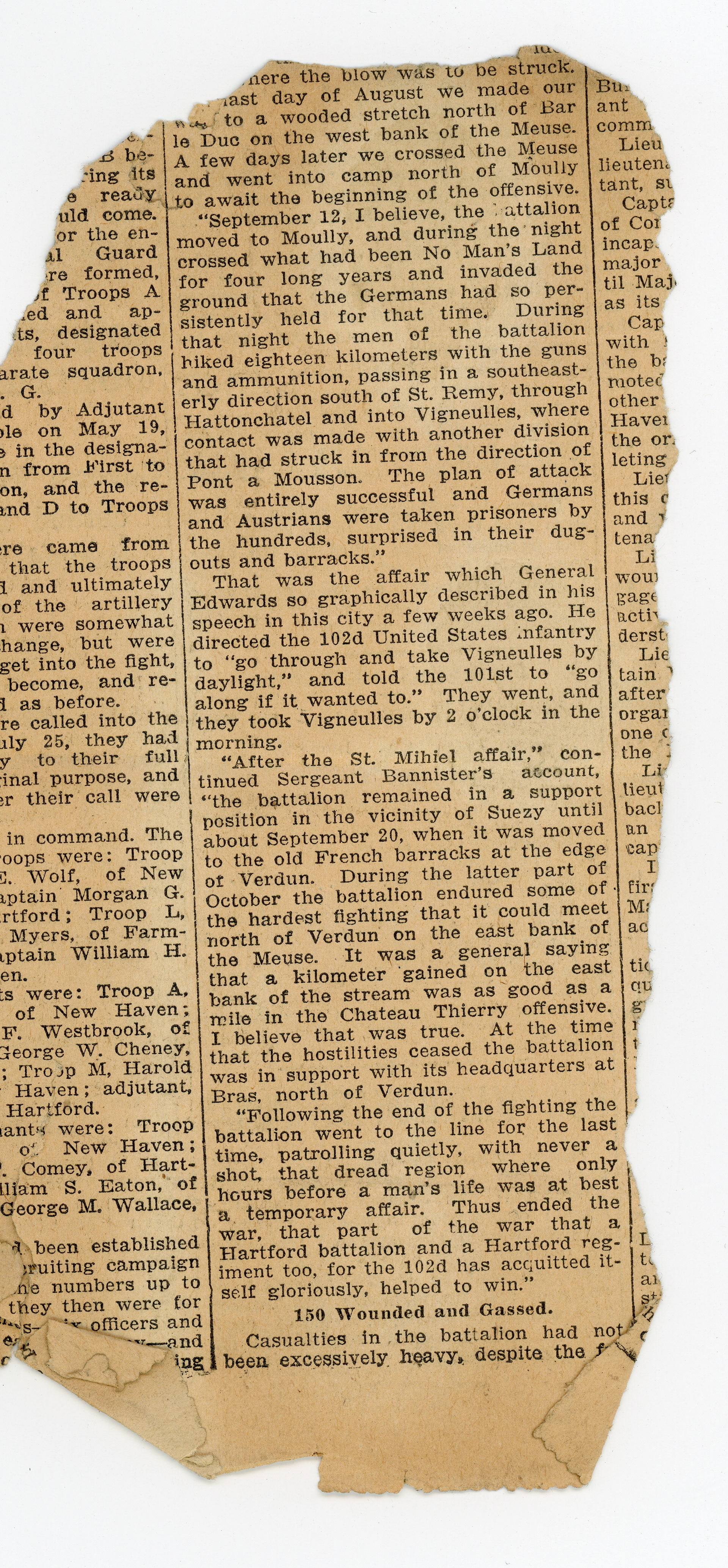
Possibly a clip that my grandpa sent home.
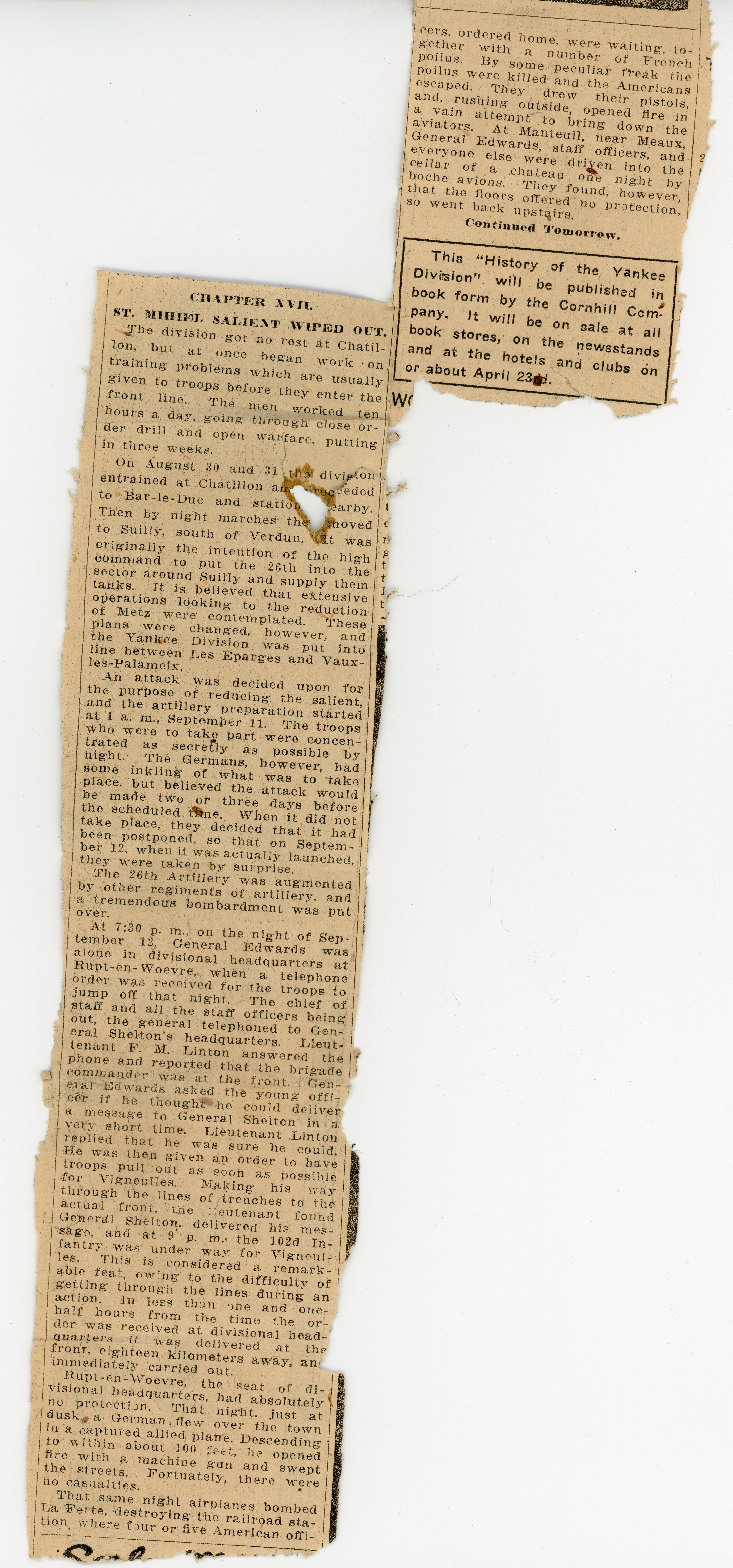
One of the battles my grandpa fought in, described more briefly in the clip he may have sent home.
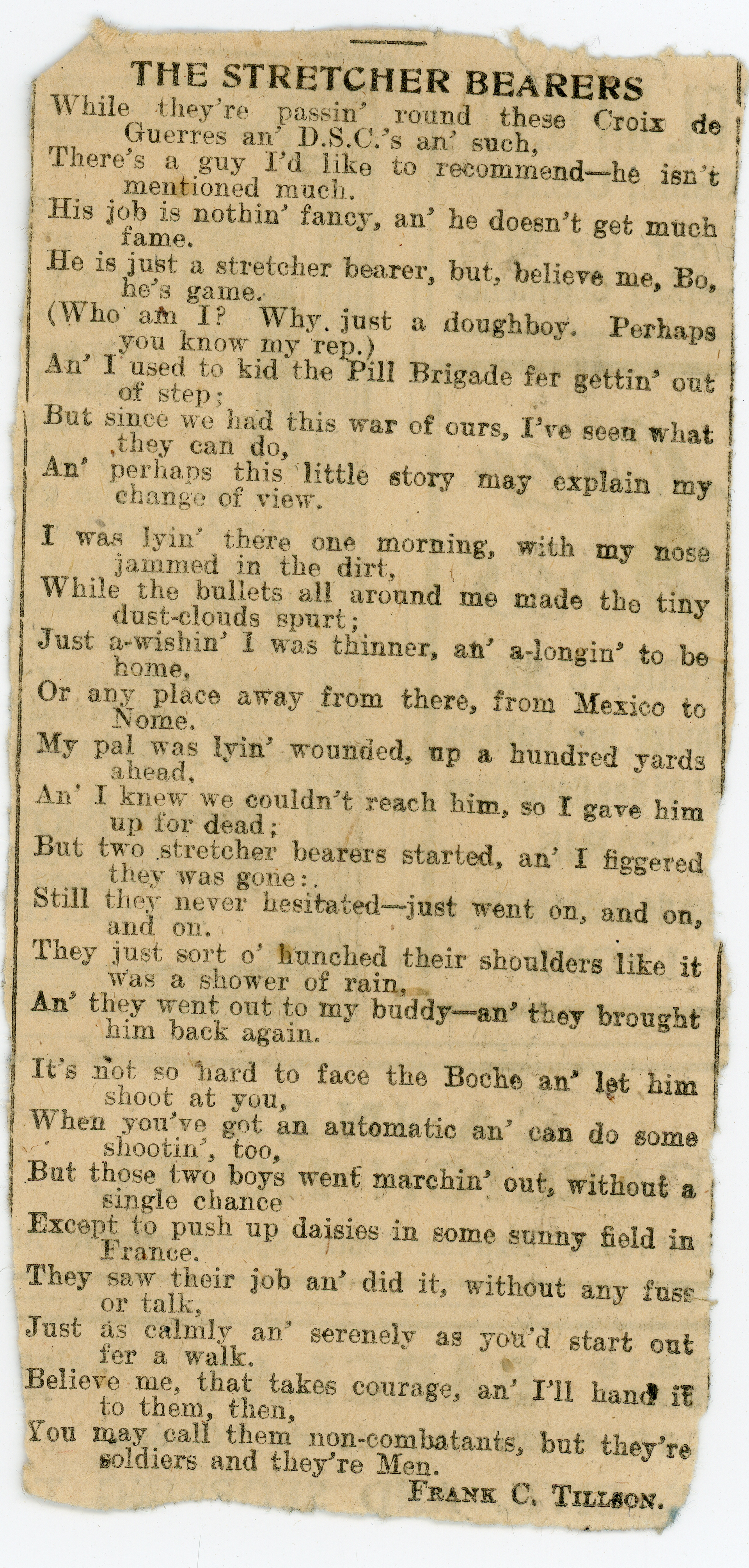
A moving ode to stretcher bearers that my grandpa saved.
“Well ma,” he closes a long letter written on Oct. 5. “I wish I could see you once more and do pray I may have the chance and do pray that you do not worry over me being over here for I’m feeling fine and not worrying over anything over here.” He lies! There's surely no lack of worry. In fact, apparently in response to his brother Leonard's question about food, he says he’s “satisfied with the eats alright, that’s the least of my troubles.”
Just a day after the letter to his mom though he has reason to hope that his troubles are over. “The papers over here state that Germany accepted President Wilson’s peace terms but how things turn out I do not know.” He closes that letter with the hope that the peace sticks so that he has the chance to eat his Christmas dinner at home.
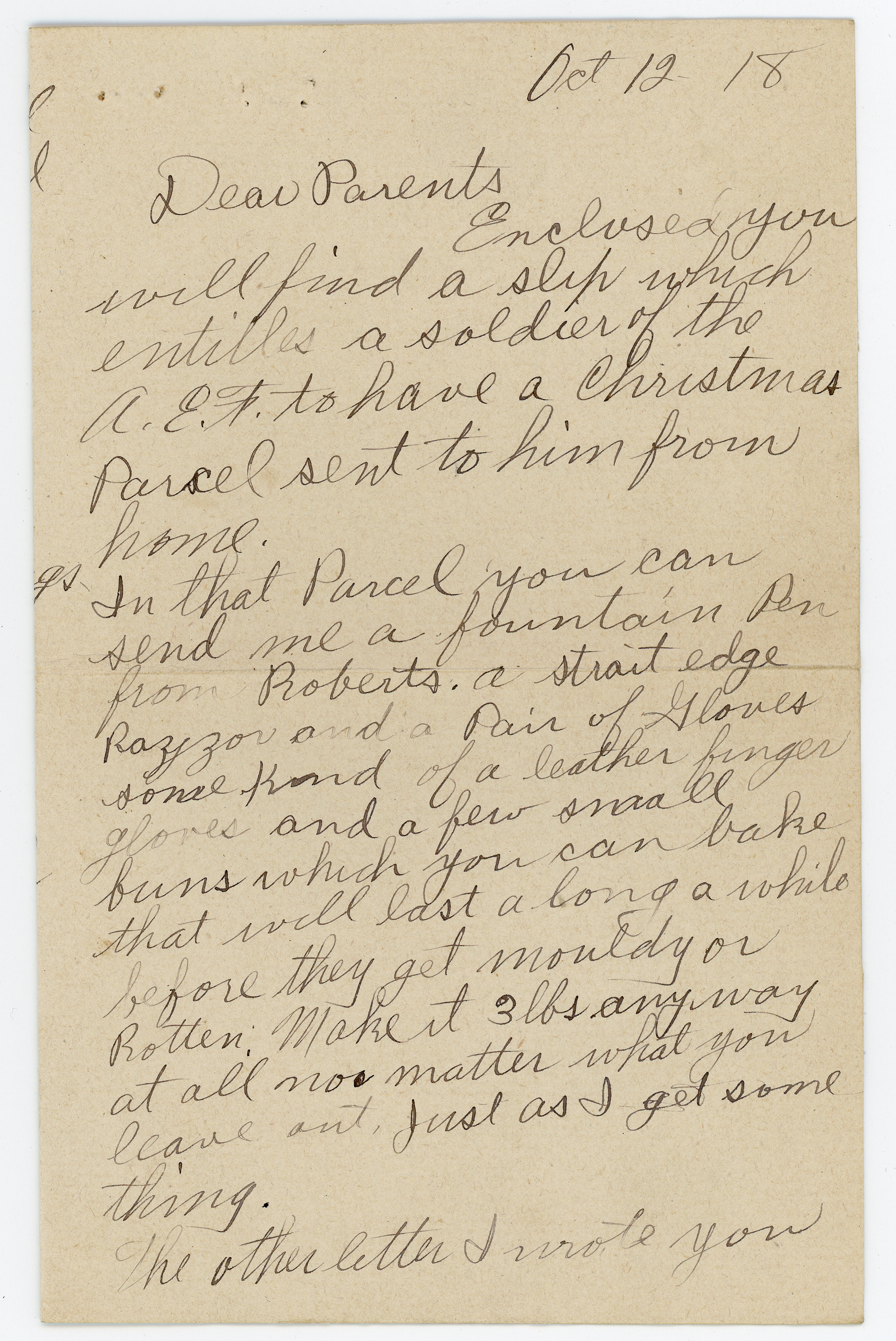
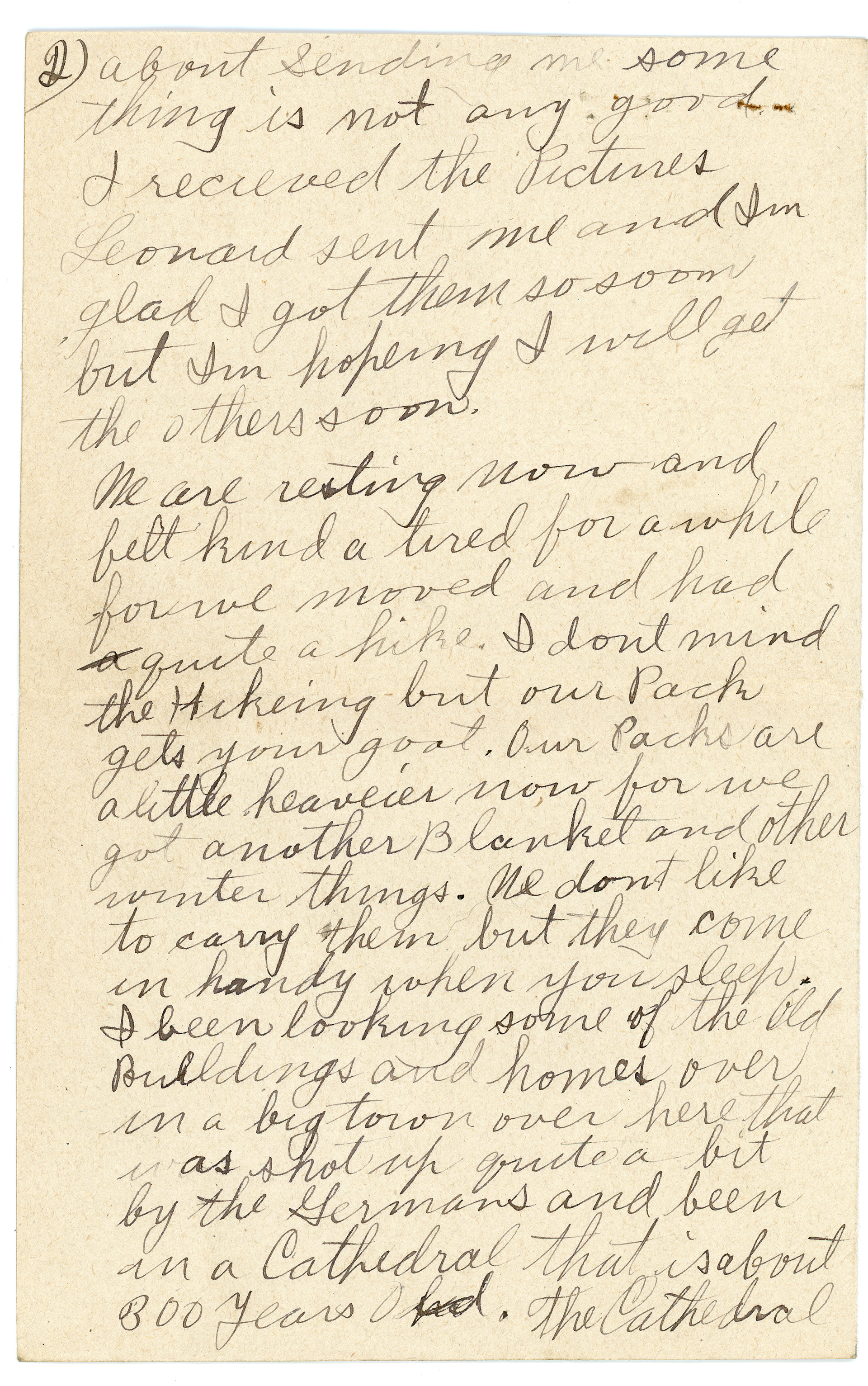
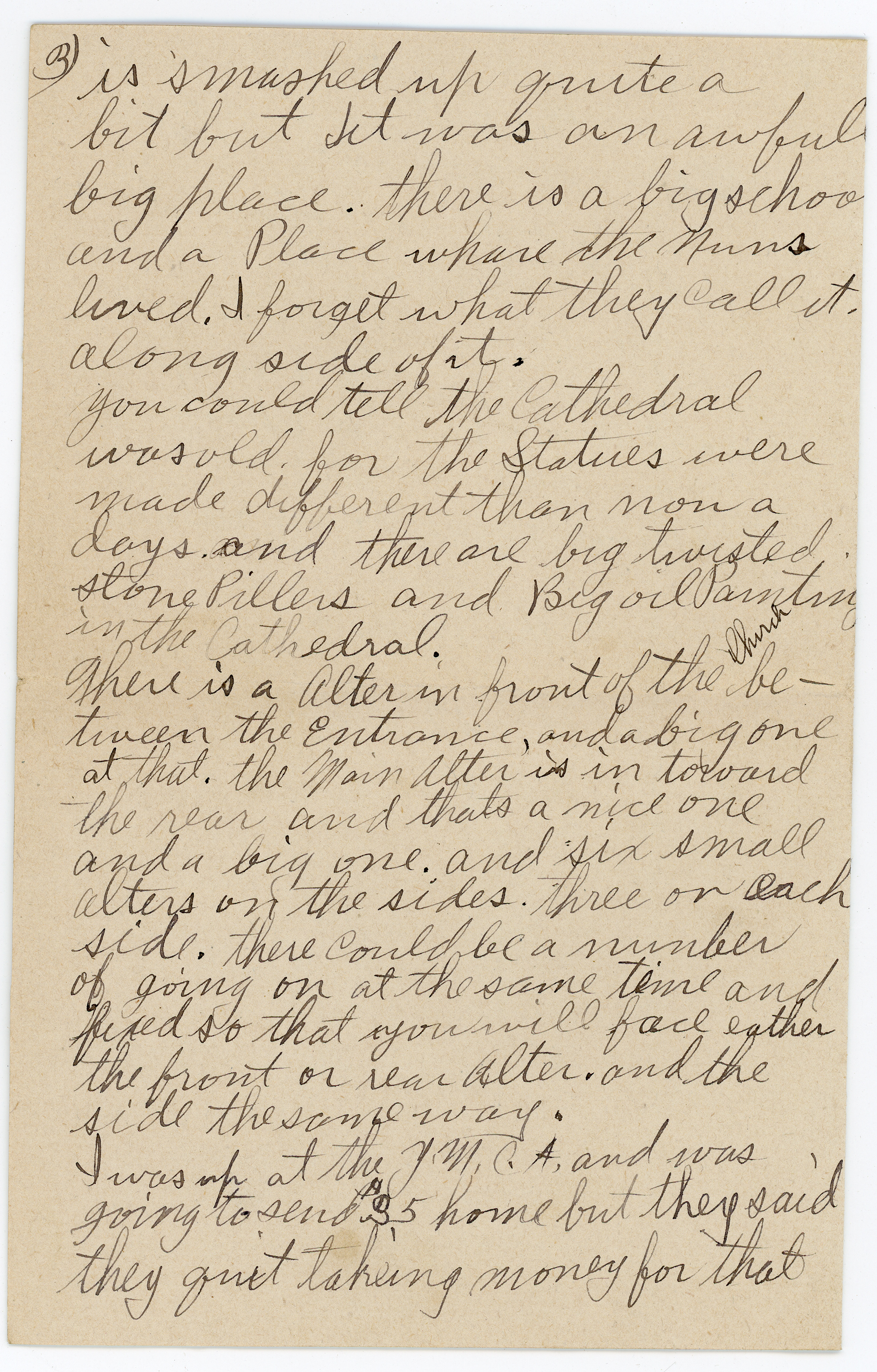
On Oct. 12, my grandpa writes to his parents that he’s on a bit of a break. “We are resting now and felt kind of tired for a while for we moved and had quite a hike. I don’t mind the hiking but our pack gets your goat. Our packs are a little heavier now for we got another blanket and other winter things. We don’t like to carry them but they come in handy when you sleep.” I wonder if he’s referencing the moment when he could barely walk any further and his friend helped him along. By Oct. 12 he's been on the move what sounds like nearly constantly, hiking at night and enduring long drives and constant bombing. He describes in detail a big bombed out church that could very well be the cathedral at Verdun since according to his notebook he arrived there on Oct. 10. You can read the full letter below.
Sign up for updates. Share this post on socials.