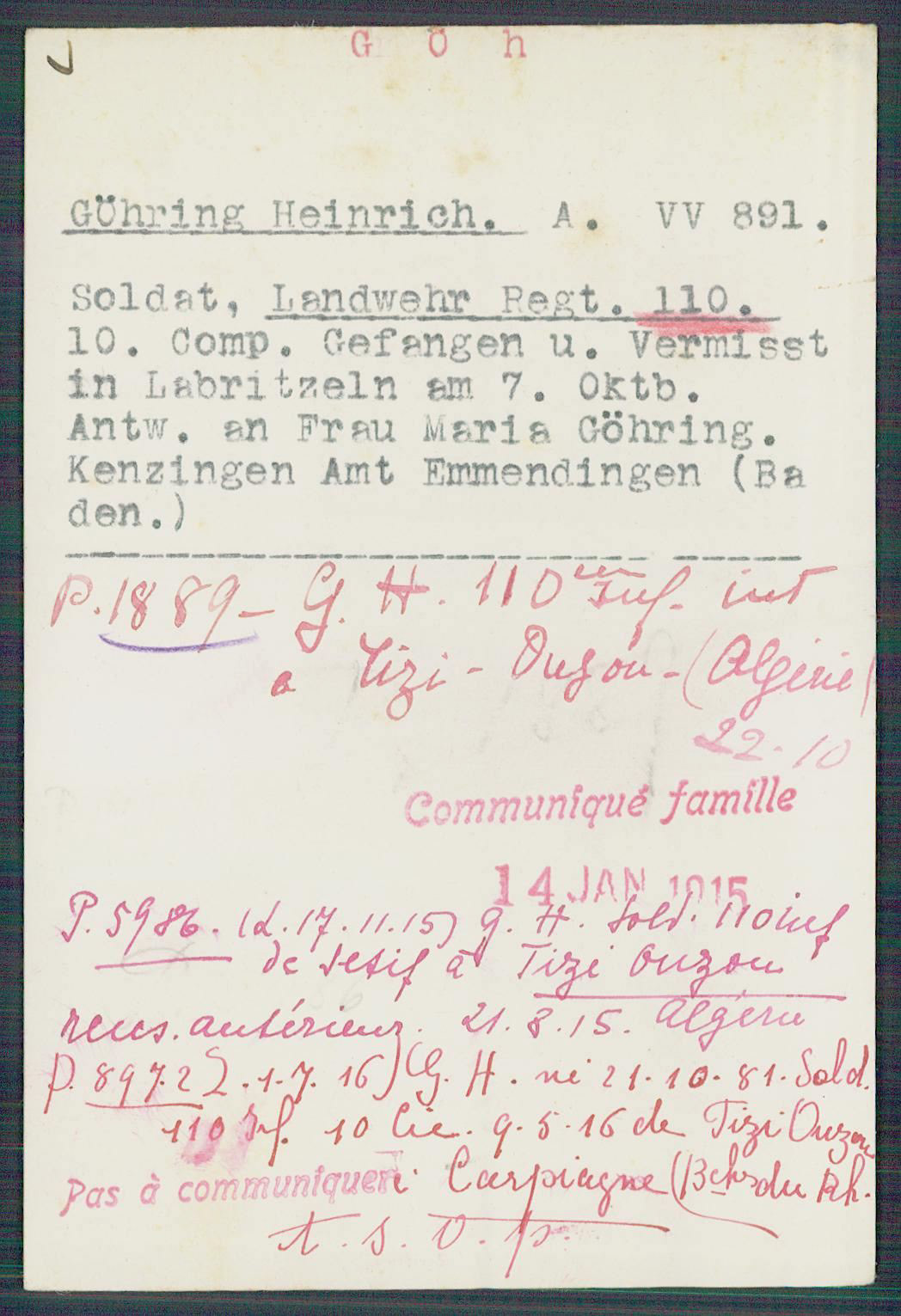
I think this references his capture
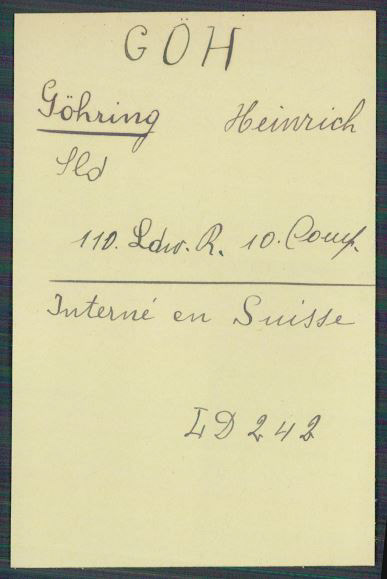
A reference to Switzerland

The malaria ledger reference
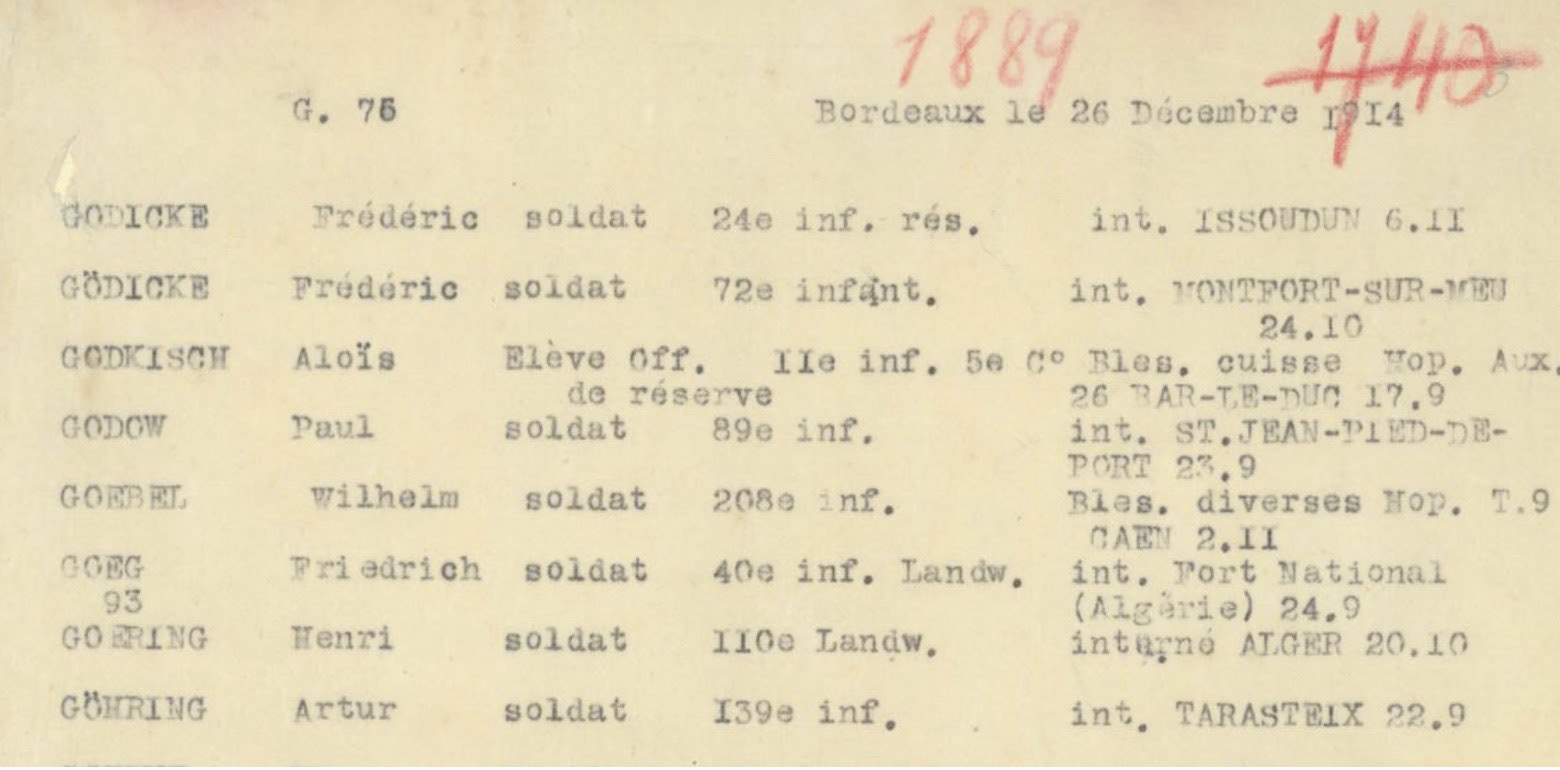
One of the ledger entries
According to the International Committee for the Red Cross, 10 million people were detained in camps in WWI. Countries involved in the war were asked to track prisoners and provide records to the Red Cross, which has now digitized those records and made them available online.
Digging into the Red Cross records has been challenging but fun, especially when I stumble on a connection or translate some French or German to discover a really significant piece of the puzzle of Heinrich’s story.
The first breakthrough for me when trying to decipher the documents was finding the “Gorings”. I started looking for Gohring, which is how it's spelled in the letters, and found none. But I know it's a common name in Germany and that there are lots of ways to spell it -- Göring, Goering, Goehring, Gohring, Göhring and also variations of Gering – so I kept looking and eventually discovered that all of those spellings are listed on the website under “Goring”. And wow, there are a lot. There are records for 251 “Gorings” including nine Heinrichs!
The records for individual people might include one or several cards with a bunch of cryptic letters and numbers on them. In our Heinrich’s case, his top record actually spells his name Goehring, so I initially ignored it. I ultimately dug into all nine of the Heinrichs but figured out that the group of cards topped by the one spelled Goehring is correct (at least I’m convinced it is) despite the misspelling, based on how the dates and locations line up with information that Rosa and Heinrich share in their letters. Also, all the cards either identify him by birth date or his military division, sometimes both, so it's pretty clear that they're all about the same guy, even if his name is spelled Goehring, Gohring or Göhring. The officials apparently weren't real concerned with getting the spelling exactly correct.
All of the cards have one or more alphanumeric codes that correspond to pages in ledgers. You can search on the Red Cross website for that alphanumeric code to see the page in the ledger. I haven’t found every single ledger page for all the numbers – in some cases I can’t decipher the writing. But I’ve found quite a bit of Heinrich’s path and one piece of information that made me gasp.
In the below I’ve used the records on the Red Cross website and some of the letters to create a timeline that tracks Heinrich’s movements:
October 7, 1914: This is when Heinrich got captured. I think the typewritten German on one of the cards translates to Heinrich’s “company captured and missing” on Oct. 7 – that’s the same date Rosa tells Franz that Heinrich was captured. The card also shows that there has been communication with the family and names Heinrich’s wife, Maria.
January 14, 1915: A letter from Rosa to Franz shares a Tizi Ouzou, Algeria, address for Heinrich.
March 12, 1915: Rosa tells Franz that Heinrich is now in the “vast Sahara,” and she shares his address in Biskra. There’s also an undated record in the Red Cross files showing his transfer to Biskra and of course we also have Heinrich’s postcard with the image of Biskra on the front so we know he's there at some point.
August 16, 1915: A postcard from Heinrich to Franz shows an address in Michelet, Algeria. Michelet was apparently the French name for a town currently called Ain El Hammam (according to Google).
August 21, 1915: This is when things get a bit weird because there seems to be a lot of back and forth between Michelet and Tizi Ouzou. On this date, Red Cross records show Heinrich in Tizi Ouzou.
October 17, 1915: Heinrich seems to be back in Michelet as a letter from Rosa to Franz shares an address for him in Michelet.
February 13, 1916: Following a letter in January 1916 where Rosa says that Heinrich is “extremely unwell,” in a Feb. 13 letter she says he’s no longer in Michelet but is in Tizi Ouzou.
May 9, 1916: Red Cross records show Heinrich is transferred from Tizi Ouzou to Carpiagne, which is near Marseille, France.
May 20, 1916: Red Cross records show him transferred to Agen, in the South of France.
June 8, 1916: This ledger entry is the one that made me gasp. After the date appears the word: Paludisme. I almost ignored it since it follows “Agen H. Annexe” which I figured referred to his exact location in Agen. But then I googled it and discovered that Paludisme is the French word for Malaria.
October 22, 1916: In June and September, Rosa and Heinrich both write to Franz and reference that Heinrich has been in the hospital in Agen for multiple months. In October, Rosa shares his address which includes “hospital for the Germans.”
December 12, 1916: I’m not entirely clear what this Red Cross record, dated Dec. 12, 1916 means but it seems to indicate “place of transfer” is Agen-Toulouse.
December 24, 1916: The day before Christmas, Rosa sends a brief note on a postcard to Franz. It starts with this: “Dear Brother, I am happy to inform you that a few days ago I received a letter from Switzerland.” It was in regards to prisoner of war Heinrich Gohring who is now in Davos, she writes.
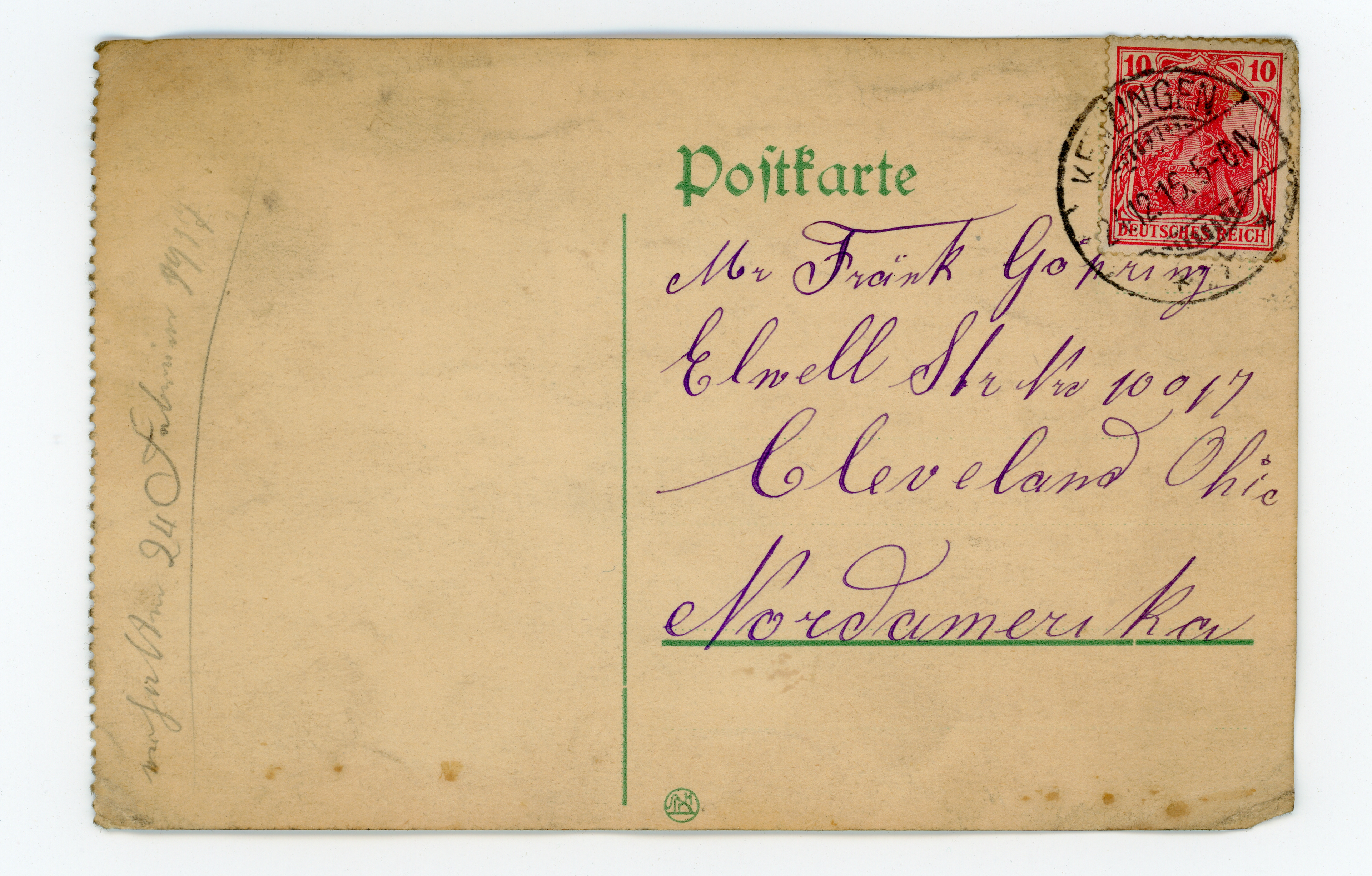
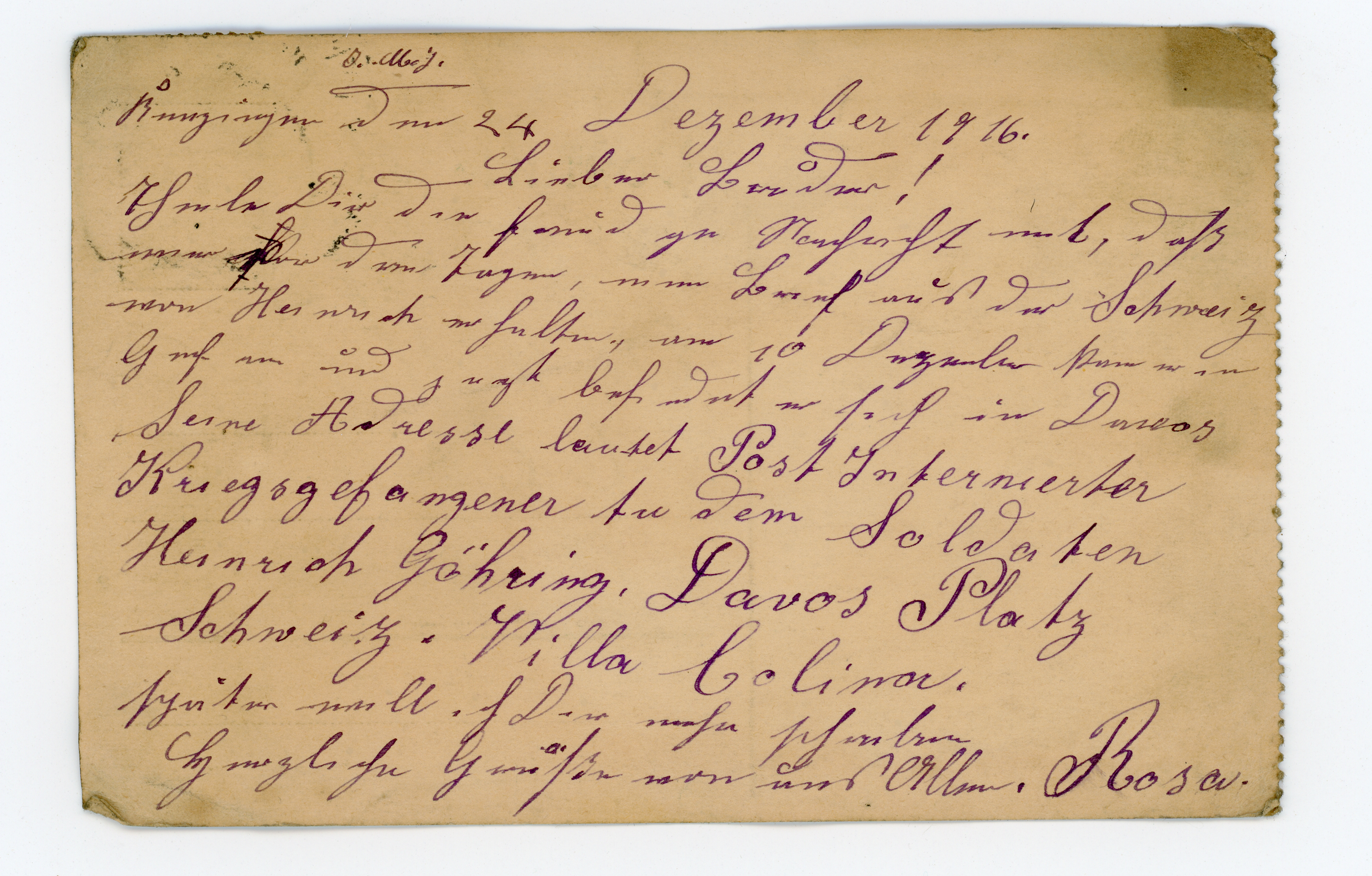
Rosa's letter indicating Heinrich's move to Davos
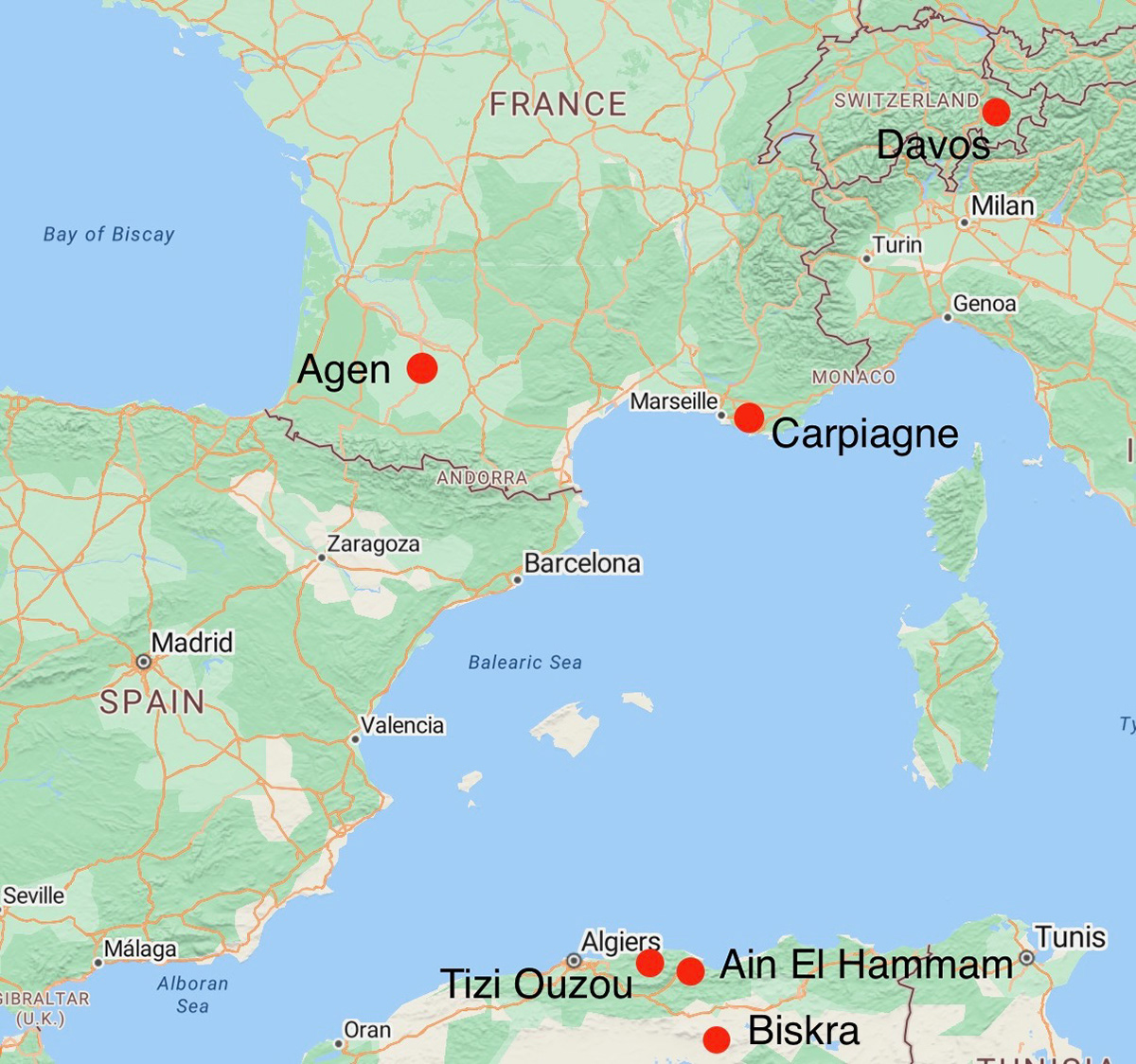
Franz's locations. Ain El Hammam is the current name for Michelet.
There is so much to unpack about Heinrich’s journey so far as a prisoner of war. One is that he seems to move around a lot. I'm suspicious about the back and forth between Michelet (Ain El Hammam) and Tizi Ouzou in part because Tizi Ouzou is the name of a town and a province, and Michelet is in the province of Tizi Ouzou. I suppose it's possible that the records may say Tizi Ouzou when he's actually in Michelet. Or maybe he's not actually moving but the way his mail is supposed to be addressed changes. With better translations of the letters I might be able to figure that out.
Also, Heinrich has been held captive for more than a year at this point and almost from the start he’s been sick. Nonetheless, even once he gets moved from Algeria to the south of France, he’s still being sent to work – he references working in the fields while in France and Rosa says he’s doing railroad construction while in Algeria.
I previously had seen references to Davos in Rosa’s letters so I suspected that Heinrich had eventually been sent there but wondered why. If Wikipedia is correct, the Swiss pretty early on in the war agreed to take very ill prisoners. Wikipedia says there was a specific list of conditions that made you eligible to be sent to Davos and Malaria isn’t on it. So either Heinrich had something else going on as well (the list includes “serious nervous problems” and “serious mental illnesses,” neither of which sounds like a big leap for anyone experiencing war) or perhaps his Malaria symptoms were somehow bad enough to get him sent there.
Another twist is that Rosa manages to travel to Davos very quickly after she finds out he's been moved there. In a letter dated Jan. 7, 1917, she tells Franz that they’ve been visiting since Jan. 3. “What a beautiful area, I have never seen such a beautiful town, and a very healthy region. I would really like it here if I could stay. Heinrich will be seen here, well taken care of.”
But I can't imagine that she actually saw him. Were POWs allowed visitors? I don't know but I find that really unlikely. It's a question I need to do some more digging into.
There are interesting happenings in Rosa’s life that she shares in the letters throughout this same time period and I expect to touch on some of them in future posts.
Sign up for updates. Share this post on socials.